
Context Is the System: On "I Am Sitting in a Room"

Alvin Lucier’s I Am Sitting in a Room is often treated like an art-school koan: “the room starts to harmonize,” “identity dissolves,” “sound becomes space.” All of those are basically true, but can make the piece feel mystical when it’s actually the opposite. It’s a clean, almost brutally literal demonstration of one fact: you cannot remove the room. If you keep reintroducing a sound to an environment, the environment will eventually dominate the sound.
The procedure
The piece is a process, not a performance in the usual sense.
A person reads a short text in a room and records it.
That recording is played back into the same room and re-recorded.
The new recording is played back again and re-recorded again.
Repeat until the speech is no longer intelligible and what remains is the room’s resonant character.
The text is also the instruction set. The narrator tells you exactly what he’s doing and why — he’ll keep playing it back “again and again” until the room’s resonant frequencies reinforce themselves and “any semblance” of the speech is destroyed (rhythm aside).
That’s it. No metaphor required.
What changes (and what doesn’t)
At the start you have language: a human voice carrying meaning. Then, iteration by iteration, the piece teaches two things at once:
Intelligibility decays. Consonants smear. Vowels bloom. The sentence loses its ability to carry semantic content.
Resonant identity emerges. Certain frequencies keep being reinforced by the room’s geometry; others are attenuated. Over time, the recording becomes a portrait of that particular space’s resonances.
What doesn’t change is the mechanism: the room is being asked the same question repeatedly, and it keeps answering in its own voice — until its answer overwhelms yours.
So the punchline isn’t “the voice turns into a drone.” The punchline is more uncomfortable: context is not background. Context is the structure.
Why “removing the room” is a fantasy
Audio culture loves the fantasy of extraction: isolate the vocal, remove the mud, eliminate the harshness, clean the noise floor: strip away the “bad” so the “real” remains.
Lucier shows you what that fantasy forgets. Repetition doesn’t purify a signal. It reveals the environment — and eventually the environment becomes the signal.
That’s a perfect metaphor for mastering, and also a warning.
Because “context” isn’t only room acoustics. Context is:

the monitoring chain and its biases,
the loudness expectations of the genre,
the emotional intent of the mix,
the artist’s tolerance for gloss,
the listener’s playback reality.
When someone says, “Can you fix it in mastering?” what they often mean is: can you remove the consequences of upstream choices without touching identity?
Sometimes you can help, or clarify. But Lucier’s logic remains: there’s no intervention that is purely corrective. Every “fix” is also a translation of character. The question isn’t whether you’re changing it. The question is whether you’re changing it toward itself or away from itself.
Lucier makes this visible because he turns “room coloration” — the thing we treat as a nuisance — into the protagonist. He takes what engineers are trained to eliminate and makes it the whole story.
A Jungian angle
One of the smartest details is that Lucier’s text is explicitly personal, even vulnerable: he notes his stutter and frames the piece as partly a way to smooth it out through the process.
So there’s an ego-message at the beginning: this is me speaking, here, now, in this room. There’s a human desire in it: to be heard clearly, to be free of an impediment, to have language land clean.
Then the system takes over.
Reading Jung helps me see that the personal narrative doesn’t vanish because it was false; it vanishes because it’s smaller than the structure it’s inside. The room — impersonal, physical, indifferent — doesn’t care about your meaning. It has its own laws, and your voice becomes a carrier wave for them.
“The larger structure speaks” doesn’t mean “the cosmos has a message for you.” It means: there are patterns you inhabit that you can’t talk your way out of. You can only come into right relation with them, by listening.
Objectivity as trained listening
At the ending of I Am Sitting in a Room Lucier shows you what’s left when intention collapses: rhythm, resonance, the stubborn fingerprint of place and time.
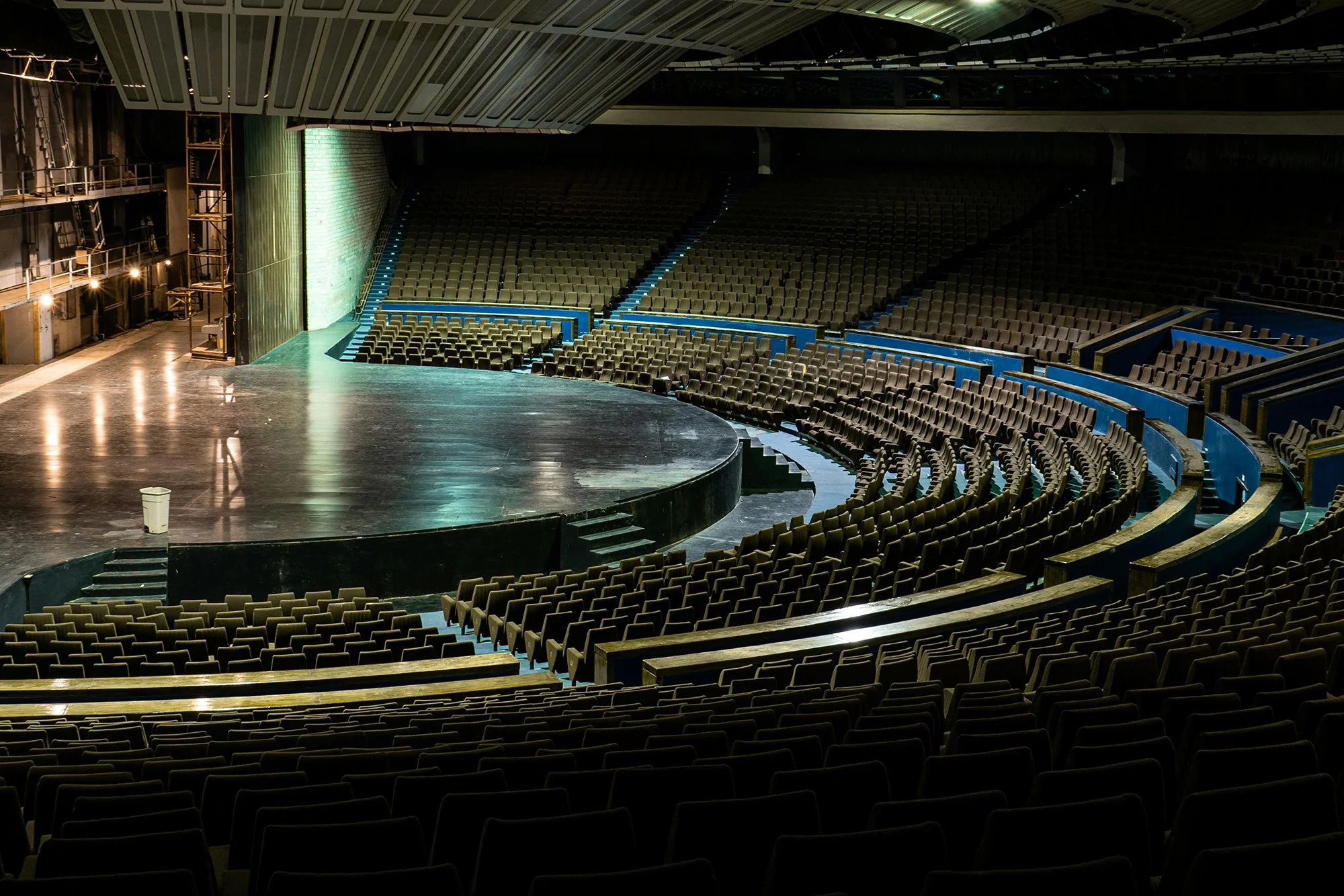
That’s why I keep coming back to it as a model for objectivity. Can you keep listening after your preferred story collapses? Can you recognize what the system is doing, even when it’s not flattering to your self-image, your taste, your need to be the author?
In mastering, that’s the line between control and care.
If you’re honest, you’re always working with rooms — literal rooms, cultural rooms, psychological rooms. The most disciplined work isn’t pretending the room isn’t there. It’s hearing it clearly enough to decide what to do with it, and what not to do against it.
Lucier didn’t make a piece about sound becoming abstract. He made a piece about truth: what keeps asserting itself after your intentions stop mattering.