
The First Thirty Seconds: What a Mix Is Already Telling You

The file opens and for a moment I try not to think.
Those first few seconds are one of the last places in this work where the record can arrive before my habits do. Once analysis hardens it becomes difficult to hear anything except through the categories I already have: brightness, density, vocal position, low-end stability, image, impact. Those distinctions are the job. If they arrive too early they stop being tools and start being a filter.
So the first listen is disciplined in a particular way. I am listening closely without converting each perception into an intervention.
An indie rock mix comes in, dark and restrained, made by people who care more about atmosphere than spectacle. The guitars have a clean ringing coldness that reads as a Pavement kind of ambition: tension without gloss, shape without unnecessary mass. The vocal is reaching for something exposed and slightly frayed, the sort of tone that around The Bends could feel physically close without ever being polished into a different register. The references make sense. I can hear the aim.
I can also hear, almost immediately, where the record is not yet holding the weight of its own intention.
The chorus arrives and does not land with the force the song has earned. Not because it needs to be louder in the simple sense; it is loud already. The feeling does not step forward when it should. The section opens without deepening. The vocal is present but is not held with enough authority for the emotional turn to register, and the guitars have mood while some of their energy sits in the wrong place, which leaves the center of the song slightly unclaimed. The upper presence that would let the vocal arrive is there in fragments rather than as structure. Nothing is broken. The song is not failing. But inside thirty seconds I can hear the distance between what it is trying to be and what the mix is currently letting it become.

That distance is where the work begins.
People sometimes talk about mastering as though the first question is which chain you reach for: what EQ you favor, what sits across the bus, what kind of enhancement suits a track like this. Those questions are not irrelevant. They are late. Before any of them there is a quieter sequence that matters more. What do I trust in this mix. What reads as intention and what reads as drift. What can be clarified without altering the identity of the song, and what is merely obscuring it.
That chain is attentional before it is technical.
The ear goes to the vocal first, because this song is asking for a kind of intimacy, and intimacy depends on whether the human center of a record can carry through the arrangement without sounding pinned to the glass. I am not yet asking whether the vocal is too dark or too bright in the abstract. I am asking whether it is being allowed to mean what the performance is trying to mean.
Then the ear moves outward. How are the guitars framing that voice. Are they creating depth or occupying space. Is the darkness dramatic, or is it masking a failure of legibility, because there is a version of moody that is only evasive. A mix can hide inside its own weather. This one is close to that line without being on the wrong side of it. The intent is real and the problem is proportion.
A mix arrives carrying evidence. Evidence of what the artist wanted, and evidence of what happened while they were trying to get there, and those are not always the same thing. You can hear conviction in a record. You can also hear overwork, indecision, attachment to a texture that stopped serving the song, a compensation made early and then built around, a compromise that became an aesthetic because time ran out, a chorus that was meant to bloom and got managed instead. None of that needs moralizing. Records are full of decisions and decisions leave a trace.
Part of the job is hearing the intention and part of it is hearing past the intention.

That distinction matters because service to the work is not obedience to every surface feature of the mix. If an artist wants a song that is dark and still legible, fidelity does not mean preserving every dulled edge that accumulated on the way. It means preserving the mood while helping the song read that way outside the room where it was made. If the guitars are doing something genuinely good and are also crossing the vocal's path, admiring the reference and leaving the collision alone is not respect. Translation requires choices.
The first listen is therefore not neutral, and it is worth being honest about what different people are doing during it. You can listen for deficiencies to correct, which produces competent records with the character sanded off. You can listen for level, width, density, and how competitive the thing could be made, which is a real commercial question and answers none of the others. What none of that reaches is the question I think actually comes first, which is what this record is trying to preserve as it crosses into public life.

That crossing is the threshold. A song in the studio is still private in a meaningful sense: revisable, defensible, misunderstood by only a few people. Once released it is public fact. It will be heard in cars and kitchens, on headphones during bad commutes, through phone speakers in rooms too noisy for subtlety. It will be absorbed into moods the artist did not choose, misheard, loved for the wrong reasons and dismissed for the same ones. None of that can be controlled. What can be controlled, for one short final interval, is whether the record leaves the room with its center intact.
So when the first chorus fails to widen, I am not thinking about how to make it bigger. Bigger is easy, and increasing the mass of a record is usually the least interesting thing available. I am asking what is preventing the section from arriving as the song understands itself. Is the vocal failing to step through because the upper mids are congested at exactly the frequencies where consonants carry, in which case the guitars and the voice are competing for the same two or three hundred hertz of intelligibility. Is the chorus being asked to deliver emotional force without enough structural separation from the verse, which is a dynamics question and not a spectral one. Would harmonic excitation in the right place hold the center steady, or would it brighten the song into a different register altogether. These are technical questions in the service of a reading.
That is what the work is at its best: a reading precise enough to become action without becoming vanity.
The first listen is also frequently wrong, and any account of this that leaves that out is selling something. Your ear adapts within a minute or two, so the thing that seemed glaring at fifteen seconds sometimes turns out to be a characteristic you were simply unaccustomed to, and the thing you did not notice at all becomes the actual problem by the third pass. So I write the first reading down and I do not act on it. I listen again the next day, cold, and compare. What survives that comparison is the reading. What does not survive was a reaction to unfamiliarity, which is a real perception and a poor guide.
Sometimes the reading says to do very little, which is among the harder outcomes to accept, because every tool invites narration. With a preset a click away, any intervention produces the satisfying impression that something is happening. But there are records where the serious labor is protecting proportion rather than adding force. A vocal does not always need more level; sometimes it needs the material around it to stop leaning on the same perceptual real estate. Darkness does not always need correcting; sometimes it needs one small point of clarity so that by contrast the darkness reads as chosen.
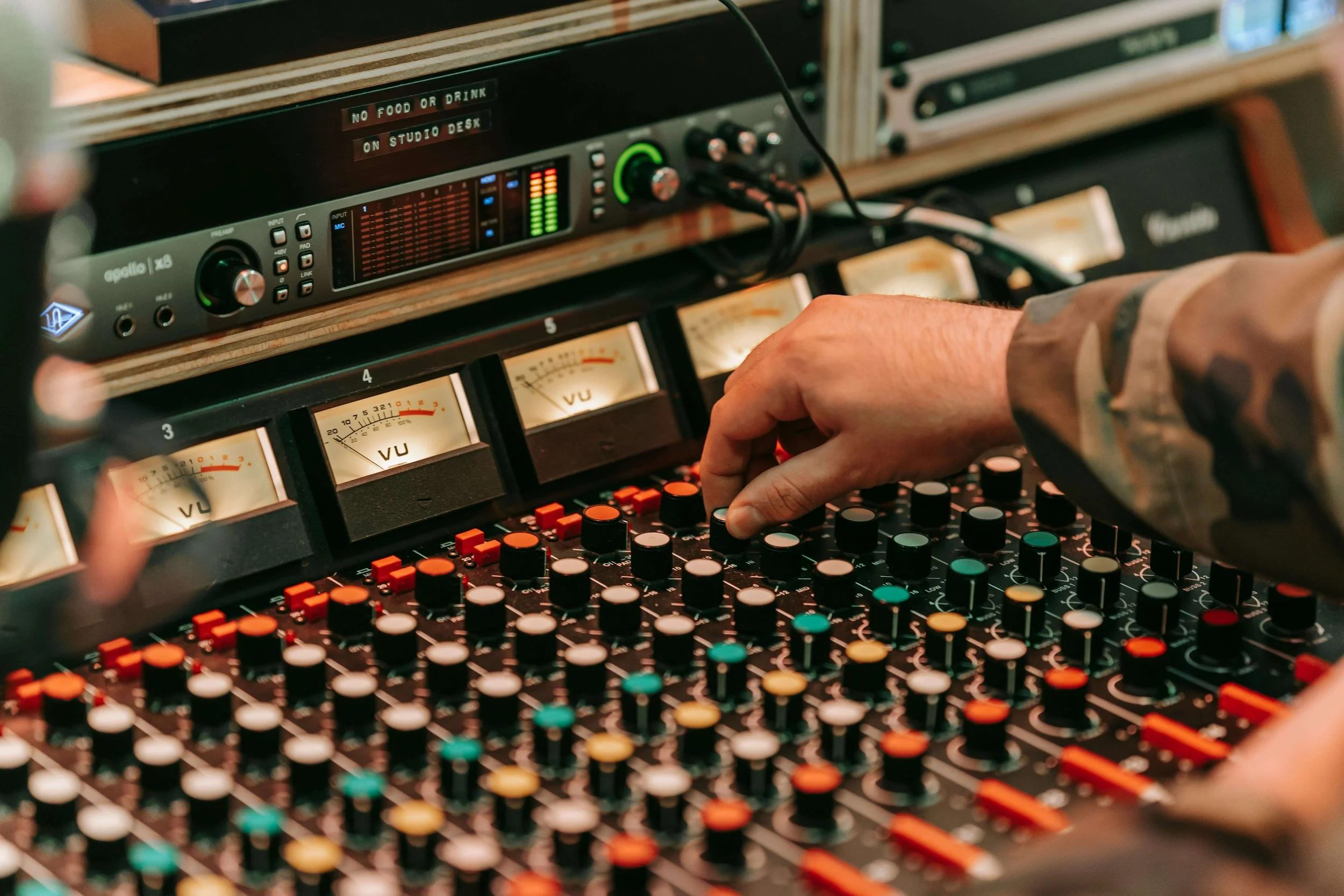
Those are small decisions in the room and they are not small in consequence. What the vocal is finally allowed to be depends on them, and so does whether the low end grounds the record or merely weighs it down, whether the guitars function as atmosphere or as obstruction, whether the song stays moody in the way the band meant or goes dull in the places where a listener unconsciously reaches for contact. A record loses itself by degrees. No single move betrays it. Five perfectly reasonable moves might.
This is why I distrust the vocabulary of enhancement once it becomes automatic. A master can be punchier and less moving. It can be cleaner and less alive. The point is not to avoid change. The point is to tell the difference between change that helps a song survive contact with the world and change that slowly domesticates it toward a more generic idea of what music is supposed to sound like.
The first thirty seconds do not solve that problem, but they set the terms on which it gets solved.
By the end of that first listen I knew a few things about this record. The band was reaching for a darkness that still needed definition. The chorus deserved more consequence than the mix was giving it. The vocal wanted a nearness that only works when the middle of the mix genuinely holds. The guitars were beautiful in the right way and were leaning just far enough into the vocal's path to keep the song from arriving. It did not want polish and it did not want scale. Lean, tense, legible, slightly haunted. Clean ringing tones with the mood intact. It wanted to be itself, more fully.

What followed from that was smaller than the reading. A narrow subtractive move where the guitars were crossing the vocal's intelligibility band, which recovered the center without touching the overall darkness. A gentle lift above that, wide rather than surgical, so the consonants had somewhere to arrive. Clipping rather than limiting on the transient peaks, because limiting would have taken the chorus's step forward with it. The total gain change across the master was under a decibel. The chorus arrived because separation improved, not because anything got louder.
Those choices matter, and they are downstream of something earlier. They are only trustworthy if the first contact was honest, because technique applied to a misreading does not correct the misreading. It magnifies it.
Someone will hear this record for the first time in a car, once, while thinking about something else. They will never know that the chorus nearly did not arrive, or what the guitars were doing in the upper mids, or that almost nothing was added. That is the correct outcome. The work is finished when there is nothing left in it pointing back at the person who did it.